- Home
- How selling works
How selling surplus wire works
One form, four photos, a buyer who reads the label. Here is exactly what happens from the moment you decide the wire is not coming back into inventory.
Start with what is identifiable
Surplus wire is easy to value once three things are known: what the conductor is made of, how the cable is constructed, and how much of it there is. Everything else is detail. If you can photograph the reel label, you have probably answered all three.
Where a label is gone, the print on the jacket usually carries the type and size — something like 12 THHN/THWN-2 or 4/0 XHHW-2 AL. A close photo of that print, plus a wide shot of the stack, is enough for a first conversation.
What to include in the request
The quote form asks for the details a buyer would otherwise have to call and ask for: contact information, city and ZIP, wire type, metal, gauge or MCM, voltage class, conductor count, reel or coil count, estimated weight, condition, reel format and loading arrangements. None of it is busywork — weight and loading decide whether the wire moves on a flatbed, a van or a pallet.
If you only know half of it, send the half you know. An incomplete request with good photos is more useful than a complete one with guesses.
What we do with it
A buyer reviews the submission against what we can actually place and resell. You get a response about the wire itself: whether it fits our scope, what condition issues matter, and what the next step would be. There is no obligation and no charge for the review.
We do not publish a price list, and we will not quote a number before seeing the wire. Copper and aluminium values move, and two reels of the same gauge can differ sharply in value depending on insulation, voltage class, age and storage.
Pickup, freight and loading
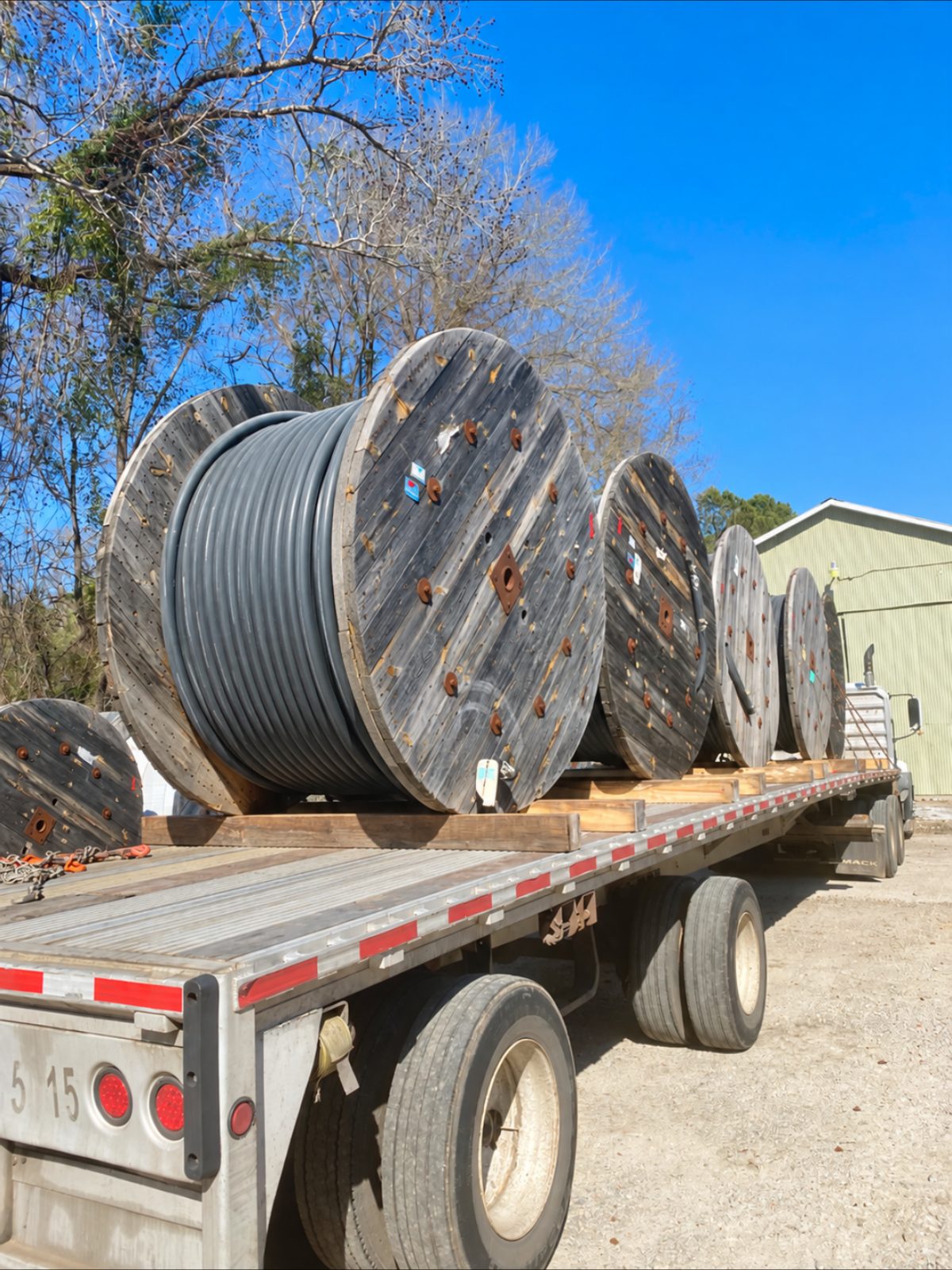
Most Oklahoma sellers are within practical range of an arranged pickup. We ask about dock access, forklift capacity and whether reels are palletised because that determines the truck and the labour.
If you would rather ship, we can receive inbound freight and confirm the count on arrival. Either way, the count and condition are confirmed at loading, against what was described in the request.
What we cannot take
Transformers, switchgear, breakers, MCCs, generators, bus plugs, chillers, machinery and general scrap metal. If a load is mixed, set the wire aside and send that on its own.
Talk it through
From rack to settled
The same sequence applies whether you have six reels or six pallets.
Photograph and count
Reel labels, jacket print, one wide shot. Count reels, coils or boxed units.
Submit the form
Four photos and the details you have. Note the city, ZIP and loading situation.
Get a real answer
A buyer responds about scope and next steps. If it does not fit, we tell you.
Move the wire
Pickup or freight is arranged, the count is confirmed at loading, and terms are settled.
Photo guidance that saves a phone call
The reel label, straight on. Most labels carry the manufacturer, the type, the size, the voltage rating and the footage. One clear frame of that label is worth several artistic shots of the yard.
The jacket print, close. If there is no label, photograph the printing on the cable itself. Include the whole line of text, not a crop of the middle.
The end of the reel. A shot into the exposed conductor shows whether it is copper or aluminium and whether the strands are clean or oxidised.
The stack. A wide shot tells us the reel diameters, whether they are palletised, and roughly how much floor space the wire occupies.
Uploads are capped at 10 MB total per request. If you have more photos than that, email them to saleselectricalbuyers@gmail.com and reference your city in the subject line.